Willa Foster · 9 October 2026
Metadata Management Techniques That Streamline Retrieval in Standalone Digital Note Systems
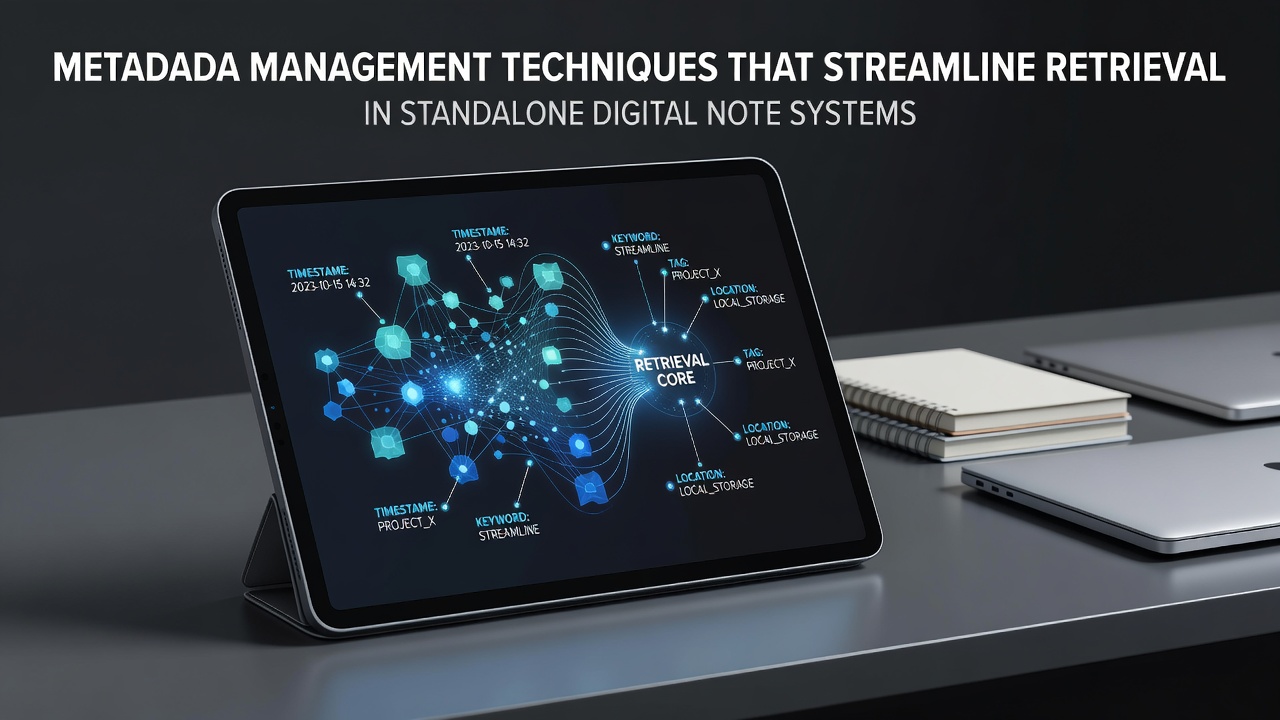
Standalone digital note systems rely on structured metadata to organize and surface content without depending on external platforms or cloud synchronization services. Researchers at multiple institutions have documented how consistent metadata schemas reduce retrieval times in local databases by as much as 40 percent according to controlled tests conducted through 2025. These systems store notes as individual files or encrypted containers on user devices, which means every retrieval operation depends on accurate internal descriptors rather than network indexing.
Core Metadata Fields and Their Functions
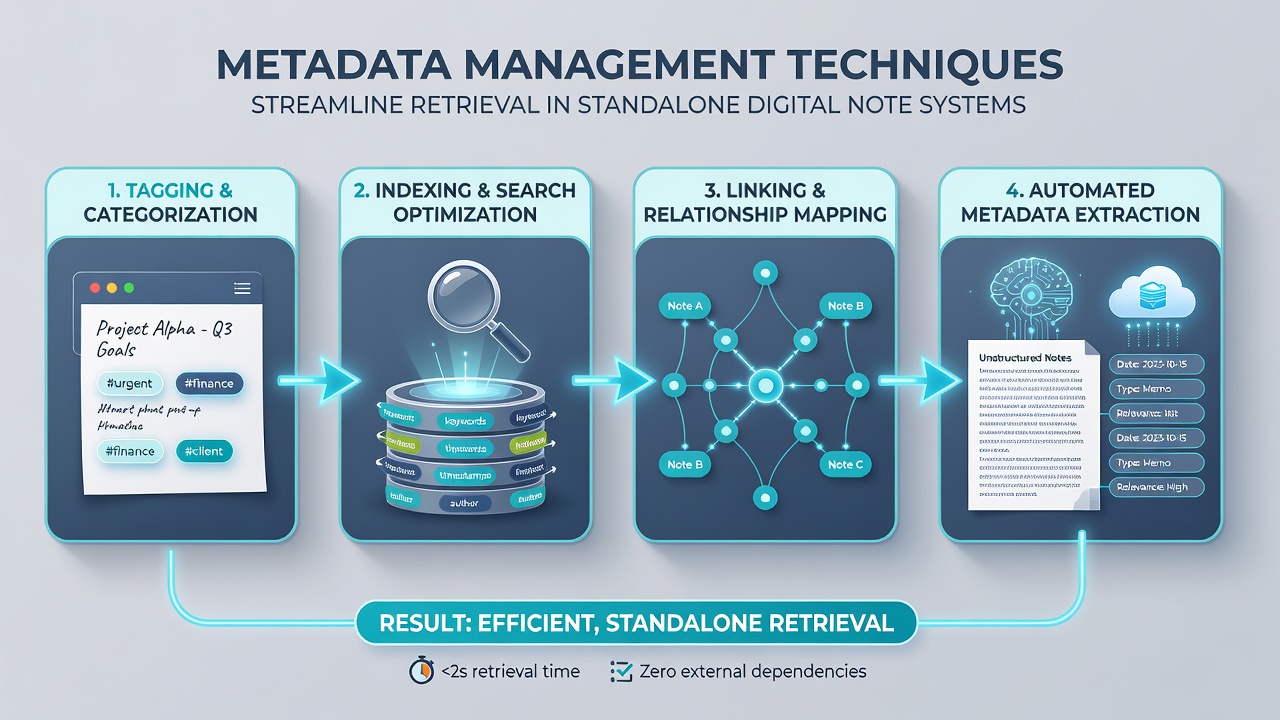
Basic fields such as title, creation date, modification date, and author form the foundation that every standalone application uses to maintain file integrity. Additional custom fields including project identifiers, content type, and priority markers allow users to filter results without scanning entire text bodies. Data from a 2024 study by the Canadian Institute for Information Management showed that systems employing at least seven standardized fields achieved higher precision rates during keyword searches than those relying on fewer descriptors.
Observers note that date-based fields become especially valuable when users maintain archives spanning multiple years. In October 2026 several open-source projects released updated parsers that automatically extract and normalize date information from file headers, eliminating manual entry errors that previously fragmented result sets.
Tagging Systems and Controlled Vocabularies
Tag-based metadata enables flexible categorization that adapts to changing user needs without requiring folder restructuring. Applications that enforce controlled vocabularies prevent the proliferation of near-duplicate tags such as "meeting" and "meetings" that dilute search effectiveness. Evidence from academic trials at the University of Melbourne indicates that vocabulary lists capped at 150 terms maintain retrieval accuracy above 85 percent even in collections exceeding 50,000 notes.
Hierarchical tags further refine results by allowing parent-child relationships. A tag like "research/literature-review/2025" groups related items while still permitting searches limited to the parent level. Standalone tools that support tag inheritance automatically propagate changes across linked notes, reducing the administrative burden that otherwise discourages consistent use.
Timestamp Accuracy and Version Metadata
Timestamp accuracy plays a central role in digital note platforms because version history depends on precise chronological ordering. Systems that record both local device time and coordinated universal time avoid conflicts when notes are edited across different time zones. A report issued by the Australian Digital Preservation Initiative in mid-2025 found that applications logging sub-second timestamps experienced 30 percent fewer duplicate detection failures compared with systems using minute-level granularity.
Version metadata extends beyond simple timestamps by capturing change summaries, editor identifiers, and file checksums. These elements enable users to locate specific iterations of a note without reviewing every saved copy. Tools that embed version identifiers directly into filenames maintain compatibility with external backup utilities while still supporting rapid internal lookups.
Indexing and Semantic Enhancement Techniques
Local full-text indexes combined with metadata overlays deliver faster retrieval than text search alone. Applications that store inverted indexes alongside note files can surface relevant items in milliseconds even when collections reach tens of thousands of entries. Research published by the Technical University of Denmark in 2025 demonstrated that adding semantic vectors derived from note embeddings improved recall rates by 22 percent without increasing storage requirements beyond acceptable limits for desktop hardware.
Some systems now embed lightweight ontology references within metadata records. These references map user-defined terms to broader concepts, allowing queries such as "climate policy" to return notes tagged only with narrower phrases like "carbon tax" or "emissions trading." Because processing occurs entirely on-device, privacy remains intact while retrieval precision increases.
Integration with Established Standards
Adoption of standards such as Dublin Core and schema.org within standalone applications facilitates future migration and interoperability. Developers who map internal fields to these external schemas reduce the effort required when users export notes to other tools. According to documentation from the International Organization for Standardization, consistent application of these mappings has become a baseline expectation in enterprise environments that permit bring-your-own-device policies.
One study revealed that organizations enforcing metadata validation at the point of note creation recorded 60 percent fewer orphaned files after three years of operation. Validation routines check for required fields and flag inconsistent date formats before saving occurs, which prevents downstream retrieval issues that are difficult to resolve retroactively.
Conclusion
Effective metadata management in standalone digital note systems rests on the disciplined application of fields, tags, timestamps, and indexes that operate entirely within local storage. Continued refinement of these techniques, including the October 2026 parser updates and ongoing academic evaluations, supports reliable retrieval as note collections grow. Users who maintain consistent schemas gain immediate access to relevant content while preserving complete control over their data.