Blake Butler · 26 September 2026
Timestamp Accuracy Plays a Central Role in Digital Note Platforms
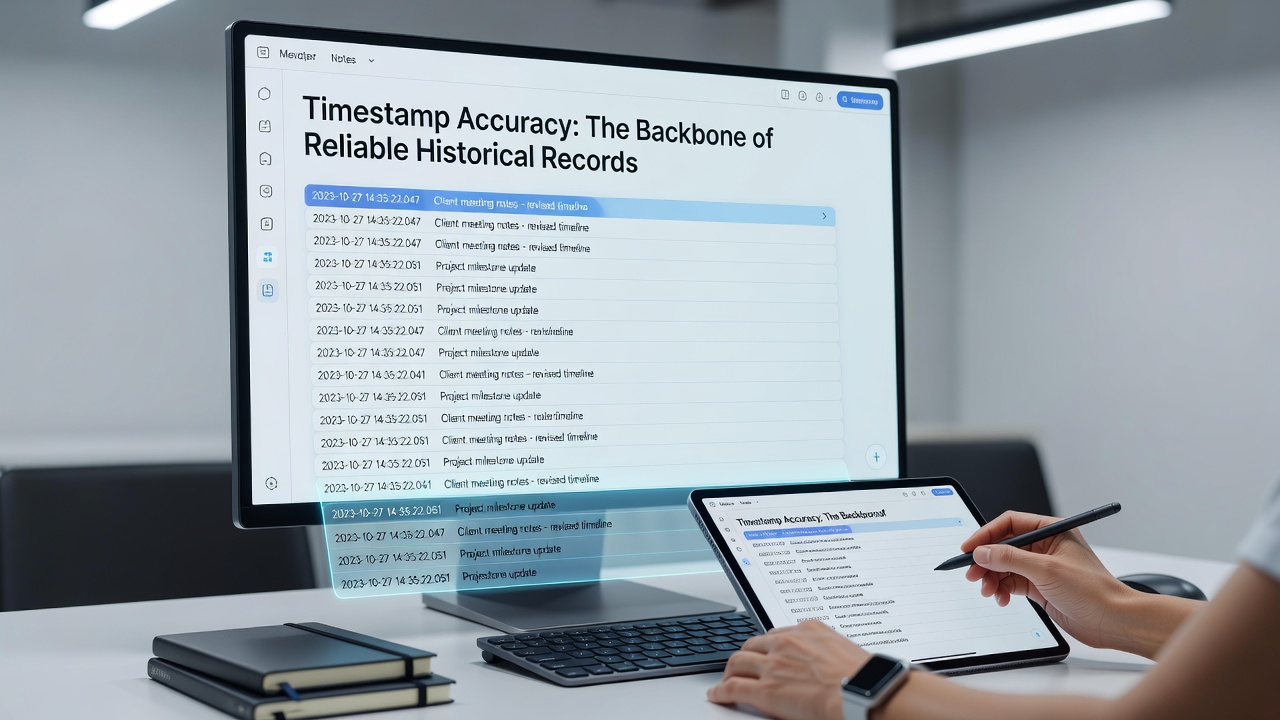
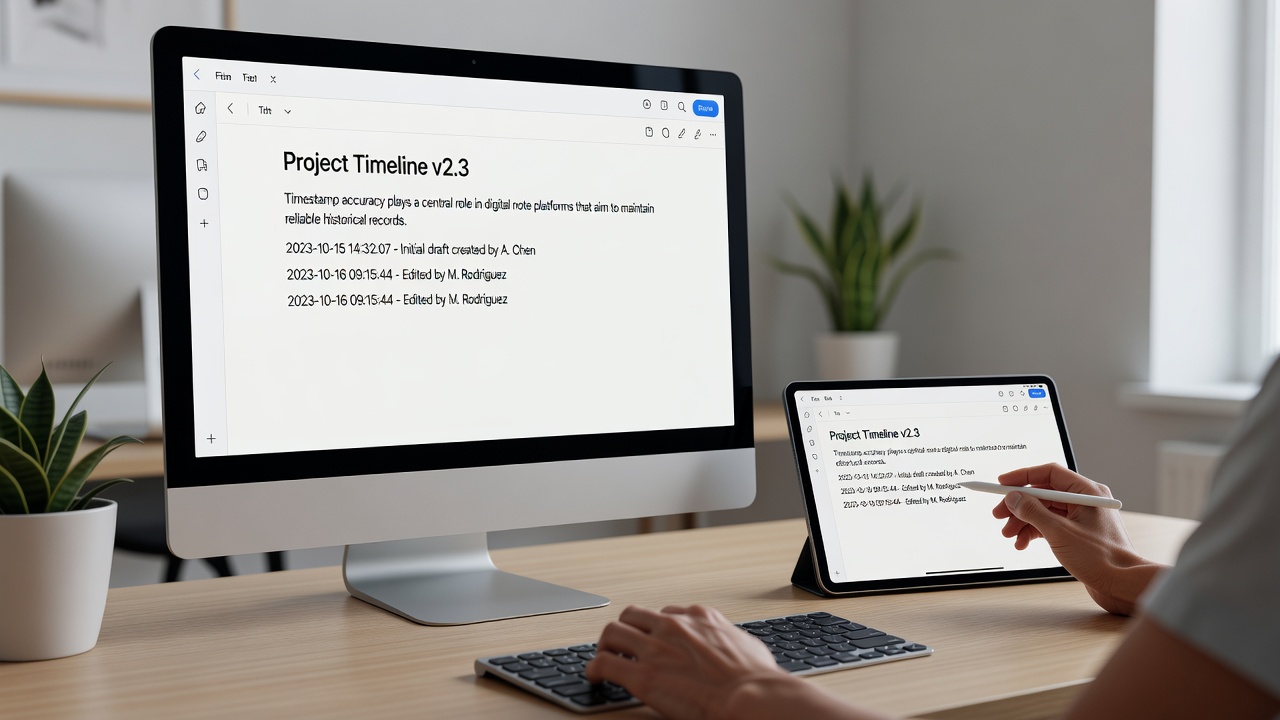
Digital note platforms rely on accurate timestamps to preserve the sequence of user entries, and this precision supports the creation of trustworthy historical records for individuals and organizations that depend on exact chronological ordering. When timestamps align correctly across devices and time zones, the resulting timelines reflect actual events without distortion from synchronization errors or clock drift.
Mechanisms Behind Timestamp Generation
Platforms generate timestamps through network time protocol synchronization with reference servers, and these systems pull from atomic clock standards maintained by national laboratories around the world. Data indicates that most modern applications default to coordinated universal time before converting to local displays, which reduces discrepancies that arise when users travel between regions or switch devices. Observers note that without this baseline, entries created seconds apart can appear out of order in shared notebooks or audit logs.
Research from institutions tracking digital record integrity shows that even small deviations accumulate over months of use, and this pattern becomes especially noticeable in collaborative environments where multiple contributors add notes simultaneously. The process involves embedding metadata at the moment of creation, then verifying it during sync operations to catch any inconsistencies introduced by offline editing or battery-powered devices that lose connection to time servers.
Challenges in Maintaining Precision Across Systems
Time zone handling and daylight saving transitions create recurring hurdles for developers who build these platforms, because automated rules sometimes fail to account for regional policy changes announced with little notice. Studies found that platforms serving international users encounter higher error rates during these periods, leading to reordered entries that complicate later searches or exports. Those who manage large archives often discover that cross-platform migrations amplify these issues when source and destination systems apply different conversion logic.
Network latency and device clock inaccuracies further compound the problem, although many applications now implement retry mechanisms and multi-source validation to mitigate drift. Figures reveal that users in remote locations with intermittent connectivity experience the most pronounced effects, since delayed syncs can shift apparent creation times by several minutes. Experts have observed that this matters most in fields such as legal documentation, medical logging, and academic research where sequence verification carries weight.
Standards and Emerging Practices
Industry groups continue to refine guidelines for timestamp formatting and verification, and these efforts draw on specifications developed by standards bodies in multiple countries. According to the National Institute of Standards and Technology, precise time distribution supports everything from financial transactions to scientific data collection, which explains why note platforms increasingly adopt similar protocols. In September 2026, updates to certain reference services are expected to improve resolution for consumer applications, potentially reducing average drift below one second in typical conditions.
Academic researchers have examined how blockchain-based timestamping offers an alternative layer of verification for users who require immutable records, and several pilot projects have tested this approach in note-taking contexts. The reality is that adoption remains limited because computational overhead and storage demands exceed the needs of most personal or small-team workflows. Still, data shows growing interest among organizations that already maintain distributed ledgers for other compliance reasons.
Impact on User Workflows and Record Reliability
When timestamps function correctly, users gain the ability to reconstruct project histories, trace decision sequences, and comply with retention policies without manual intervention. One study revealed that teams using platforms with strong chronological tools reported fewer disputes over version precedence during reviews. People who work across multiple devices often discover that seamless timestamp alignment prevents duplicate entries and preserves the intended narrative flow of their notes.
Conversely, inaccuracies force manual corrections that introduce human error and consume time that could otherwise support core tasks. Government agencies in Canada and Australia have issued guidance on digital recordkeeping that emphasizes timestamp validation as part of broader data governance frameworks, and these documents highlight the downstream effects on audit readiness. Observers note that platforms incorporating automatic conflict resolution based on precise timestamps tend to retain higher user trust over extended periods.
Future Directions in Timestamp Technology
Developers continue to explore machine learning models that predict and correct potential drift before it affects visible records, and early implementations show promise in reducing the frequency of post-sync adjustments. What's interesting is how integration with hardware security modules could add another verification tier without complicating the user experience. Researchers discovered that combining satellite time sources with terrestrial networks creates redundancy that survives localized outages, an approach already deployed in some enterprise-grade solutions.
Continued refinement of these methods will likely influence how platforms handle edge cases such as leap seconds or sudden regulatory shifts in time zone definitions. Evidence suggests that users benefit most when these technical details remain invisible yet reliable, allowing focus to stay on content rather than metadata management.
Conclusion
Accurate timestamps underpin the value of digital note platforms for anyone who depends on dependable historical sequences, and ongoing improvements in synchronization technology support that foundation across diverse use cases. As standards evolve and new verification techniques mature, the capacity for precise chronological ordering will remain a defining characteristic of reliable record systems.